Sunday, April 13, 2014

149 Years Ago (April 1865)

With the end of the spring semester closing in, I've been dealing with countless assignments since the beginning of the month. Due to this, I have been unable to post updates about important Civil War anniversaries.

April of 1865 was one of the most influential months of the American Civil War because so many turning points occurred. The biggest? After fours long years and rivers of blood, the Civil War, the bloodiest conflict in our nation's history, was finally brought to an end. However, it didn't remain that way for long. For some, the nightmares had just begun.


April 1, 1865: At the Battle of Five Forks, Confederate forces were unable to hold off the advancing Union troops and Petersburg began to crumble. The Union marched on to siege Richmond, the heart of the Confederate States of America.

April 2, 1865: the Siege of Petersburg came to an end when the city was captured. Richmond fell when the Confederate government (along with many citizens) fled as the city was bombarded and almost burned to the ground by Union artillery.

April 3, 1865: With Union troops station in both Petersburg and Richmond, General Robert E. Lee fled toward North Carolina in an attempt to meet up with General Joseph Johnston and put some space between him and General Ulysses S. Grant.

April 4, 1865: President Abraham Lincoln traveled to Richmond and walked through the streets with only a small convoy of Union soldiers protecting him. Cheers, most from emancipated slaves, rang out through the ruins. While there, Lincoln visited the Confederate White House and sat in Confederate President Jefferson Davis' chair. Meanwhile, Lee arrived at Amelia Court House. However, he found no food for his starving troops. He was forced to stop and send soldiers out to look for food. They came back with nothing.

April 6, 1865: Lee lost about a quarter of his army at the Battle of Sayler's Creek. Many of the survivors scattered.

April 7, 1865: Grant began to communicate surrender terms to Lee. These would become known as the "surrender letters."

April 8, 1865: the Battle of Appomattox Station. Confederate forces were driven back and critical supplies were captured by the Union.

April 9, 1865: Robert E. Lee and the Army of Northern Virginia surrender to Ulysses S. Grant and the Army of the Potomac at Appomattox Court House. Lee wore his finest dress uniform. Grant, suffering from a bad headache, arrived late. He wore a muddy private uniform with his own shoulder straps to show his rank. His real uniform had gotten dropped somewhere in transportation. The owner of the house, Wilmer McLean, got the honor of saying that the Civil War began in his front yard and ended in his parlor. The First Battle of Bull Run was fought on McLean's farm and the surrender terms were signed in his parlor.

April 11, 1865: Abraham Lincoln delivered a speech from a White House balcony showcasing his plans for peace, reconstruction, and what the nation would give to the emancipated African Americas.

April 12, 1865: General Grant gave a formal ceremony so the still remaining Confederate soldiers could stack their arms and surrender their flags with dignity.

If you haven't already noticed, the date marking one of the most shocking turn of events in Civil War history is missing from this list. I will be discussing it more in depth tomorrow.

Until next time.

XOXO, Kate

Sunday, March 30, 2014

Now Smile for this Camera

When we think about old photos (whether they be from the Civil War, the Victorian, or some other bygone era) we usually think of really depressed looking people in fancy clothes. However, I found an article on BuzzFeed that shows Victorian era photos of people smiling. You can see the actual article here:

 
The set includes photos like these:


That inspired me to find (somewhat) smiling photos from the Civil War era. When I say somewhat, I mean finding photos that show a happy or serene expression, not necessarily fully displayed teeth.
 
These are the kinds of images most commonly found. 


Some theories believe that everyone frowned in photos because cameras were so slow. Then there are others that say not smiling was the style of the day. Either way, though rare, you can find photos of people who looked to be enjoying their time in front of the camera.


Though he wouldn't have much to smile about come 1865 when he had to write death warrants and execution orders, assistant adjutant general Edward Townsend decided not to adopt a frown when posing for his portrait.


Depressed for much of his later life, famed Shakespearean actor Edwin Booth chose more relaxed expressions for some of his photos.  
 
 
Even Edwin's younger brother, John Wilkes, managed to sneak small grins into some of his sessions.
 
 
And then there were those who just didn't care about social conventions at all. Yes, that is a real photo (although probably taken a bit after the Civil War). I'm not sure who added the caption but it's genius. 

Until next time.

(Keep smiling)
 
XOXO, Kate

Thursday, March 13, 2014

Letters from Edwina

Edwina Booth Grossman was the only child of Edwin Booth and his first wife, Mary Devlin Booth. While visiting the Players Club, an acting club founded by Edwin, I had the chance to transcribe a letter from a young Edwina to her father. Edwin's mother, Mary Ann Holmes Booth, must have been watching Edwina while Edwin was away and also wrote her son a letter beside the one Edwina had written.

 
(Edwina and her mother)

What I find fascinating about Civil War era letters in general is that most of them are not about the war or the huge events we learn about in history class. Many are just about day to day life, who is sick, who is asking for something to be sent to them, or who is taking what classes in school. In fact, one of the tidbits Mary Ann Booth mentions to Edwin is how Edwina has a loose tooth and is excited for it to fall out.

 
(Edwina with her father)
 

The letter was written in 1867. This would make Edwina six years old.

Dear Papa,

I have been good for (unreadable word) mornings. Can I have my hair cut short? It's very warm and can I (her words became hard to read but I believe she began talking about her loose tooth).

I am going to be very good. I'll try and not get mad with Katy any more. The little birdie takes the paper in his mouth and puts it through the bars. Aunt Rosey says another little bird takes them to you. (She writes another few words about the birds but they were hard to read). 

Good bye dear papa. Make haste & come home to your little daughter.

Edwina

Kisses 60000000000000000000000

Aw, children, no matter what era they live in, are so precious. And it sounds like Edwina was very close with her father, who was known to be a quiet but loving man. Imagine having the greatest Shakespearean actor of the 19th century as your father. That must have been awesome.


(Edwina with her father and stepmother, Mary McVicker Booth)
  
Until next time.
 
XOXO, Kate

Saturday, March 8, 2014

The Civil War Recipe Box: Johnnycakes

The other day, I booked a trip for my 21st birthday. Not one for drinking until I pass out, I will instead be traveling to the beautiful Fall River, Massachusetts and spending the night in Lizzie Borden's bedroom in the Lizzie Borden Bed and Breakfast (what up). I can't wait for ALL THE HISTORY! And maybe I'll even befriend a ghost.


(Lizzie's Room - which I really want my room to look like)

While looking over the itinerary, it mentions how, the next morning, guests are served for breakfast the final meal the Borden family ate on the fateful morning of August 4, 1892. One of the listed specials was johnnycakes.

Johnnycakes are flat, cornmeal cakes that are baked or fried on a griddle. They originated as a staple food in the states around 1600. As I mentioned, they were eaten in the Borden house and, as the title of this blog hints, they were eaten years earlier during the American Civil War. Though they were eaten all across the United States, the peak of their popularity was in the Northeast.

The recipe for johnnycakes is very simple and quite fun if I do say so myself. I have made the dish before and found the cakes to my liking.

Ingredients:

1 cup of water
1 1/2 cups of ground yellow cornmeal
1/2 tsp. of salt
1/2 cup of milk
2 TB of butter

Toppings:

Syrup, molasses, or preserves can be used. The Lizzie Borden house provides powdered sugar and cinnamon as well.

Directions:

Bring 1 cup of water to a boil in a medium saucepan.
Combine the cornmeal, salt, boiled water, and milk in a medium bowl and stir well.
Melt the 2 TB butter in a skillet or a cast iron griddle over medium heat.
Pour 1 TB of batter into the skillet like a pancake to cook.
Let it cook for 4 to 5 minutes on each side until the edges are light brown in color. (Use a spatula to turn them).
Serve them hot with your choice of toppings.

That's it. If you make johnnycakes, or have tried them before, leave a comment below and tell us what you thought of them, what your favorite toppings are, or even a photo.

Until next time.

XOXO, Kate

Friday, February 28, 2014

William Sherman: The Original Wrecking Ball

As much as this is a historical blog where I like to share facts and stories about the American Civil War, sometimes I throw in a short post for humorous reasons. Plus, I'm in the mood to laugh tonight after all my multi-murderer research.

Oh, speaking of multi-murderers, last week I opened a blog about America's first documented serial killer (sometimes known as the Chicago World's Fair Serial Killer) Dr. Henry Howard (H.H.) Holmes. You can check out my "Mistress of the Murder Castle" blog here:

http://murdercastlemistress.blogspot.com/

Since it just went live, it only has two posts at the moment. However, I'll be adding more soon.

Anyway, back to the Civil War. I was listening to "Wrecking Ball" by Miley Cyrus this afternoon. Yes, I'll admit that I was listening to the "new" Miley. Though I don't care for most of her newer songs, sometimes I find a winner that sticks in my head. Of course my mind took the lyrics and gave them a historical spin. For some reason, the line "I came in like a wrecking ball" made me think about William Sherman, his March to the Sea, and the burning of Atlanta. Then I made this.


William Sherman: The Original Wrecking Ball

Until next time.

XOXO, Kate

Friday, February 14, 2014

I am, To You, A Stranger

Happy Valentine's Day :)

I'll admit it. Though I've always been single on Valentine's Day (sometimes a counselor to my friends) I'm a sucker for romance. Plus, being a historian, I love reading and writing stories about historical couples.

For example, in one of the confessions of HH Holmes, he professes a love for Minnie Williams. Yes, I'm well aware that he killed her eventually but I thought it was very romantic (that may be a bit strange but whatever). The following was a snippet from a conversation I had with one of my professors about it.

Me: See? He did have a soul.

Professor: Or he was lying to gain sympathy.

Me: It was a romantic sentiment. Don't ruin it for me.


Anyway, for many reasons, the heart of one of my favorite historical relationships beat during the American Civil War. The story of the love that existed between a northern belle and a southern sympathizer. The story of John Wilkes Booth and Lucy Lambert Hale.


(Just a note, neither of these pictures were taken during the Civil War. The photo of John was taken around the time of his first Richmond engagement in 1858. The photo of Lucy has never been dated but it was probably taken around the time she married William Chandler in 1874).
 
It is unknown when John and Lucy first met but it was most likely in 1862. Both had rooms in the National Hotel on Pennsylvania Avenue in Washington DC and may have met in or around that location. They were independent, vivacious, bold, forward thinking, and liked having control. In each other, John and Lucy met their match and carried out a loving, passionate, and sometimes intense relationship that mixed both love and war. In 1863, John proposed to Lucy and they were engaged to be married come 1865.
 
John's death (and the following events) crushed Lucy and sent her into a deep depression that lasted for the rest of her life (she died in 1915 at the age of 74. She was a mere 24 years old in 1865. He was 26). Her mourning gown was, in fact, her wedding gown dyed black. She wrote a letter to Edwin Booth, John's older brother, confessing she would have married John even at the foot of the gallows. Edwin mentioned this letter when he wrote to his sister, Asia Booth Clarke, "I have had a heart-broken letter from the poor little girl to whom he had promised so much happiness."
 
 
Most of the personal papers (diaries, letters) belonging to John and Lucy were burned and few pieces remain in existence today. Due to this, the timeline detailing the courtship of John and Lucy is somewhat fuzzy. For example, some historians speculate that John did not meet Lucy until 1865 due to a note written in Asia Booth Clarke's "Unlocked Book."

"He gave the greater part of a day to the torturing composition of a valentine acrostic to send to the lady of his love. Junius tried to be serious over his poetic agonies, but they recalled the labors of the boy at school, and now it seemed as difficult to invent as it had been to remember. Unheeding the amusement he caused, he persevered, even through the night, and the next morning he triumphantly read out his easy flowing verses; the result of his lubrication was a success. The following passage from a letter by Junius Booth after he and Wilkes had returned to New York alludes to this valentine."

"John (Wilkes) sat up all Monday night to put Miss H's Valentine in the mail, and slept on the sofa so as to be up early; kept me up last night till 3 1/2 AM to wait while he wrote her a long letter - kept me awake by every now and then using me as a Dictionary."

-Asia Booth Clarke and Junius Booth Jr.

It's impossible that John and Lucy could have first met in February of 1865. Among other reasons, he attended Abraham Lincoln's Second Inauguration as her guest in March of 1865 and it would have been unlikely for her to have brought him if they had just met.

The letter Asia and Junius speak of no longer exists. However, there is a Valentine's Day letter that has survived the test of time. The note, probably written around 1862, was very short and did not resemble the longer letter Asia referred to. Furthermore, it was signed anonymously (John wrote his name as "A Stranger"). John had gone out once with Elizabeth Hale, Lucy's older sister, and having felt no attraction to her, was trying to woo Lucy, who he had become smitten with. However, communications became misunderstood between them and she began toying with him by acting as if he didn't exist.

"Ever since our little dining room debacle, I’ve imagined that he fell of the face of the Earth and have treated his presence in my life as such. And that is a rather large presence considering we are in the same hotel and he has apparently memorized my daily routines."

-Lucy Hale (from my in-progress book about her)

This first Valentine's Day note was written before the beginning of their courtship and was one of John's final efforts to win Lucy's heart.

My dear Miss Hale,

Were it not for the License which a time-honored observance of this day allows, I had not written you this poor note...You resemble in a most remarkable degree a lady, very dear to me, now dead and your close resemblance to her surprised me the first time I saw you. This must be my apology for any apparent rudeness noticeable.

To see you has indeed afforded me a melancholy pleasure, if you can conceive of such, and should we never meet nor I see you again-believe me, I shall always associate you in my memory, with her, who was very beautiful, and whose face, like your own I trust, was a faithful index of gentleness and amiability. With a Thousand kind wishes for your future happiness

I am, to you,

A Stranger

Finally, John was successful. Lucy fell in love with the letter and eventually (when he revealed himself) with the author. He and Lucy would begin a courtship soon after, eventually become engaged, and remain together until his death in 1865.

Sometimes, when I look up from my writing and catch a glimpse of the photos of John and Lucy on my desk, I say a prayer they have found each other again.

Until next time.
 
XOXO, Kate

Wednesday, February 12, 2014

Do You Want to Build a Snowman?

Before I explain the obvious Frozen reference in the title, I have an announcement to make. My little blog has gotten 1,002 views since it opened! WOOHOO! It may seem like a small feat to all you blog veterans but, for a first time blogger, I consider this a major milestone. This is how I feel right now.


X 10...million :D

Anyway, between "snow-pocalypse" moving in and having the soundtrack to Frozen stuck in my head, I decided to post about how snow affected Civil War soldiers. Just like today, it snowed in the winter months of the Civil War. Snow didn't stop just because fighting was happening.

Aside from locking a bayonet onto a rifle and charging into a sea of death, camping in the winter was one of the hardest trials a soldier had to face. Roads became almost impossible to use and lack of activities to pass the time caused overwhelming amounts of boredom. Supplies, including food and medicine, were unable to get through the elements and many soldiers died of disease while encamped. In fact, more soldiers died in camps than on battlefields. Although winter was a time to settle down, bond with fellow soldiers, and have some fun, the winter months were also bleak, long, and a struggle for both warmth and survival.

"The view is wild, bleak, and desolate"

-George McClellan (155th Pennsylvania Infantry)

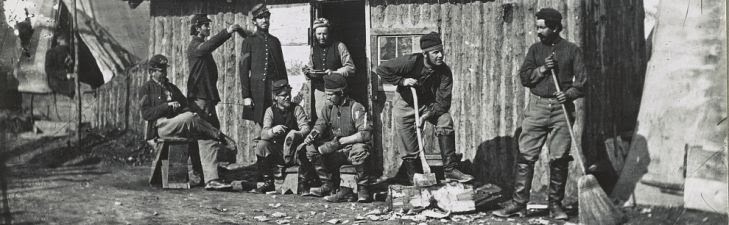
During warmer months, soldiers slept in canvas tents or wrapped in blankets on the ground. In winter, they settled into more permanent forms of lodging. "Winter huts" were built with nearby materials like trees, mud, and leaves. Some even included fireplaces. However, these were not cozy abodes. Many had serious construction problems.

"Last night was very stormy – this morning no better. Our house leaks all over, and our chimney works badly, which make things rather uncomfortable."

-Lieutenant Charles Stewart (124th New York Volunteers)

Winter camps resembled run down villages of sorts. Some had street names and even a place of worship. However, the camps lacked clean water and proper waste disposal. Disease spread faster than rats in a tenement house and death usually followed in the wake.

As I mentioned before, food and medicine grew scarcer as the war went on. When the roads became slick with ice, snow, or mud, supply wagons had trouble traversing the frozen terrain. The Confederate troops suffered much more than their northern enemies since they were under lockdown and being starved by the blockade.

"Within a few hours of Washington, men are dying of scurvy because they haven’t transportation enough to give us potatoes & onions. Some of my men are in a horrible state."

-Captain Henry Livermore Abbott (20th Massachusetts Volunteer Infantry)

Boredom among the troops was a constantly pressing issue. To combat it, soldiers established day to day activities including drilling, camp cleaning, religious services, letter writing, card games, and sharing stories. Another popular game that all ranks of soldiers gleefully participated in was snow ball battles.

"There is a string band in the regiment, and occasionally they have a serenade around the different companies and call out the Colonel and captains to make them a speech, which is generally responded to."

-Sergeant Henry G. Orr (12th Texas Cavalry)

As with all war related events, winter during the American Civil War the seemed neither romantic or heroic. Even when soldiers didn't have to load a gun for battle, they still had to struggle for survival.

"We bivouac on the cold and hard frozen ground, and when we walk about, the echo of our footsteps sound like the echo of a tombstone. The earth is crusted with snow, and the wind from the northwest is piercing our bones. We can see our ragged soldiers, with the sunken cheeks and famine glistened eyes."

-Sam Watkins (First Tennessee Regiment)


Until next time.

XOXO, Kate

(Quotes, photos, and inspiration taken from www.civilwar.org)