Saturday, July 4, 2015

7/4/63: Turning Point of the American Civil War

1863 is most remembered for the famous Battle of Gettysburg which took place from July 1st to July 3rd and eventually culminated in the Gettysburg Address. But a lesser known, however no less important event occurred on July 4th. The Battle of Vicksburg, along with the northern victory at Gettysburg, helped turn the tide in favor of the Union and promoted Ulysses S. Grant to General-in-Chief of the Union armies.

 
(Ulysses S. Grant)

Up until the fall of Vicksburg, Robert E. Lee had been kicking some major Union ass and many in the north feared that the war was becoming a lost cause. In fact, In May of 1863, Abraham Lincoln received word that General Lee had achieved yet another victory at the Battle of Chancellorsville (which lasted from April 30th to May 6th). Lincoln paced around saying, "My God! My God! What will the country say? What will the country say?" When Lincoln left the Executive Mansion, a reporter named John Russell Young quoted Secretary of War Edwin Stanton saying, "Mr. Lincoln has fully made up his mind to go to the Potomac River and there end his life, as many a poor creature - but none half so miserable as he was at the time - had done before him." (Abraham Lincoln: The War Years by Carl Sandburg). But on May 18th, Grant began what has gone down in history as one of the most remarkable campaigns of the Civil War.


(Map of the Vicksburg Campaign. Click the image to enlarge it)

Vicksburg was an important river fortress/town for the Confederacy due to its prime location on the Mississippi river. Grant had been unable to capture the area since it was well protected by extremely dangerous terrain that had made his troops vulnerable to Confederate counter strikes led by John Pemberton. But although Grant had been beaten back in the past, he had no intention of that happening again.

 
(John Pemberton)

Instead of attempting to sail directly to Vicksburg, Grant sailed below it to Bruinsburgh where he surprised and overtook Joseph Johnston who was station with his troops in Jackson.

While marching toward Vicksburg, Union and Confederate troops met at Champion Hill. "The Hill of Death" would become the site of the bloodiest conflict in the Vicksburg campaign but Grant would emerge victorious and force the battered Confederates to retreat behind the walls of Vicksburg.


(Union forces pursuing retreating Confederates at the Battle of Champion Hill on May 16th)
 

After failing to attack Vicksburg head on, Grant decided that he would lose fewer men if he starved the fortress into surrender. Just as Lincoln had blockaded the South, Grant set up his own blockade around Vicksburg, bleeding dry the soldiers and civilians inside.
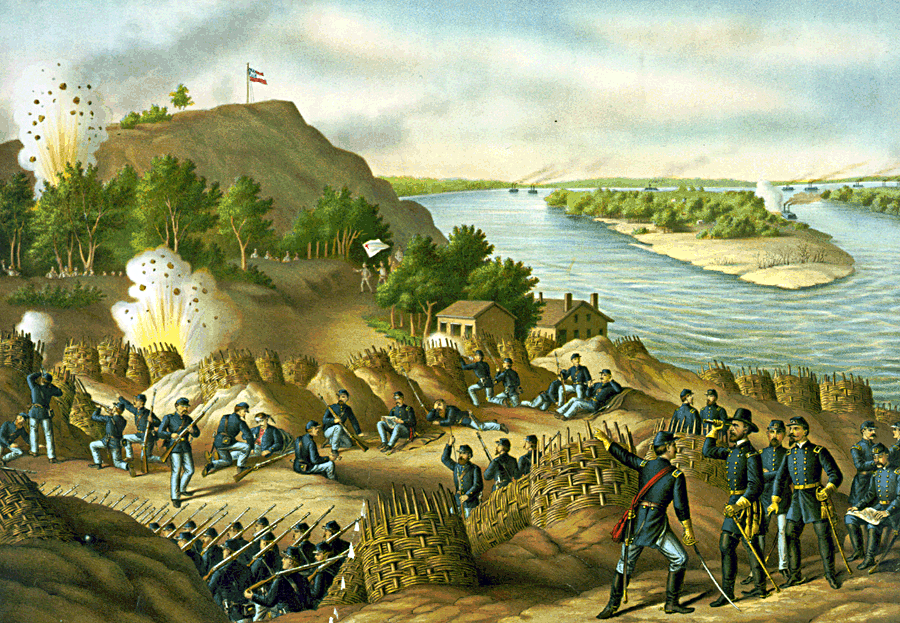
 
(Grant can be seen in the lower right corner looking out over his entrenched troops toward Vicksburg) 

After 47 days, Pemberton gave up his forces and allowed Grant, his troops, and much desired food and medical supplies to enter Vicksburg.

 
(Union troops-said to be the 4th Minnesota-entering Vicksburg in this painting by Francis Millet) 

About 110,000 troops engaged in the campaign (77,000 Union and 33,000 Confederate). 806 Union soldiers died. 3,940 were wounded and 164 either went missing or were captured. 805 Confederates perished. 1,938 were killed and 29,620 went missing or were captured/surrender to Grant. (Figures from civilwar.org)

President Lincoln was thrilled to receive news of Grant's victory, especially so soon after the Battle of Gettysburg, and wrote to him a few days later.

My dear General

I do not remember that you and I ever met personally. I write this now as a grateful acknowledgment for the almost inestimable service you have done the country. I wish to say a word further. When you first reached the vicinity of Vicksburg, I thought you should do, what you finally did -- march the troops across the neck, run the batteries with the transports, and thus go below; and I never had any faith, except a general hope that you knew better than I, that the Yazoo Pass expedition, and the like, could succeed. When you got below, and took Port-Gibson, Grand Gulf, and vicinity, I thought you should go down the river and join Gen. Banks; and when you turned Northward East of the Big Black, I feared it was a mistake. I now wish to make the personal acknowledgment that you were right, and I was wrong.

Yours very truly
 

A. Lincoln

"With the Mississippi River now firmly in Union hands, the Confederacy's fate was all but sealed." (civilwar.org)

 
(Grant at Vicksburg)

May God bless America, from sea to shining sea, in the home of the free because of the brave.

Until next time.
 
XOXO, Kate

Monday, April 13, 2015

Now He Belongs to the Ages

I can hardly believe that the 150th anniversary of President Lincoln's assassination is almost here.

Tomorrow night Ford's Theatre will be hosting "Now He Belongs to the Ages: A Lincoln Commemoration." This once in a lifetime event will be "a moving commemorative tribute to President Abraham Lincoln, 150 years to the day since his assassination" and will include "readings of Lincoln’s words and stories, Civil War-era music, excerpts from Lincoln’s favorite theatre and operas, and more. The event seeks to remind us that we not only lost a president; we lost a man who treasured his family, his friends and his country with a love so strong it could hold the Union together."


For those who could not secure tickets, the event will be streamed live at the Smithsonian National Portrait Gallery in Washington D. C. and online at the Ford's Theatre website.

Click the following link if you wish to visit the Portrait Gallery: Lincoln at the Portrait Gallery.

Click this link if you want to see the event virtually: Lincoln Online.

Also, check back here (and on the BoothieBarn twitter) for updates throughout the evening.

It's about to go down, everyone.

XOXO, Kate

Saturday, April 4, 2015

Assassination Smithsonian

Most of us know that the 150th anniversary of President Lincoln's assassination (April 14th) is just ten days away (bring on the tissues). In honor of the sesquicentennial, Smithsonian Magazine has published two different issues packed with lots of interesting conspiratorial facts.


Since the issue with Booth's derringer pistol on the cover is the regular edition that gets sent to subscribers, SmithMag (my personal abbreviation) has generously thought of us nonsubscribers and published some of the articles online. Just click the links below to start reading:

The Blood Relics From the Lincoln Assassination by James Swanson

The Spiritualist Who Warned Lincoln Was Also Booth’s Drinking Buddy by Terry Alford

The Closest Source We Have to Really Knowing John Wilkes Booth Is His Sister by Paige Williams

What the Newspapers Said when Lincoln was Killed by Harold Holzer

The one featuring John Wilkes Booth and Abraham Lincoln as cover models is the collector's edition which you have to purchase in order to read. Luckily, it is readily available at any location with a newsstand. (So no excuses if you haven't gotten one yet).

T-minus ten days to ALL THE LINCOLN FEELS.

XOXO, Kate

(Picture courteous of boothiebarn.com, which you should all go check out right now because of it's sheer Lincoln assassination awesomeness. And you can quote me on that).

Tuesday, October 7, 2014

The Civil War Recipe Box: Corn Pudding

The hiatus is over. I'm officially back with more Civil War tidbits and I decided to start with a tasty one. (Also, it's almost 8 o'clock at night and I've spent the afternoon working on a history paper. My writing skills are faltering).

Anyway, here is another installment from the Civil War Recipe Box. Corn Pudding. As before, this recipe can be found in Roxe Anne Peacock's History Lovers Cookbook. (Which is available on Amazon). And if you are interested in other Civil War era cookbooks, the Surratt House Museum in Clinton, Maryland sells the Surratt House Museum Cookbook which also has a wonderful collection of recipes. (The book is available at the museum and on their website. www.surrattmuseum.org)

Ingredients:

4 cups (or 6 ears) of fresh sweet corn. The husks and silk must be removed.

1 tablespoon of unsalted butter, melted and slightly cooled.

1 teaspoon of salt.

1 teaspoon of granulated sugar.

4 large eggs, well beaten.

1 cup of whole milk.

3 tablespoons of all purpose flour.

Directions:

Preheat the oven to 350 degrees.

In a large bowl, add the 4 cups of fresh corn.

Add the butter, salt, sugar, and eggs.

Stir with a wooden spoon.

Add the milk and flour and stir until mixed.

Pour the mixture into a 7.5 X 10.5 inch buttered baking dish.

Bake the pudding for 1 hour at 350 degrees or until a knife (or toothpick) inserted into the middle comes out clean.

Happy feasting.

Until next time.

XOXO, Kate

Wednesday, August 27, 2014

A Message from Miss Kate

Hi everyone.

I know it has been some time since something new has been posted. These past few weeks have been very busy and filled with various time consuming tasks, including an end of summer trek to Washington DC (which, rest assured, you will be hearing about very soon).

This week I began my third year of college and have been working on completing assignments, getting comfortable back on campus, and memorizing my constantly changing schedule (I had to switch around a few classes this semester).

Anyway, since I refuse to write, post, and have you read half formed thoughts, this message is here to tell you that this Down Yonder Diary will be going on hiatus for the next few weeks so I can focus on school work and finding an internship. I am NOT closing the blog forever. This is merely a short break. In fact, I have some great posts planned (including a tour down John Wilkes Booth's escape route) so make sure you stay tuned.

Until next time.

XOXO, Kate  

Wednesday, July 23, 2014

Tomb Raider: President Abraham Lincoln vs. Dr. H. H. Holmes

This is the first time I'm doing a cross blog post and intertwining my Civil War blog with my Murder Castle blog. The Lincoln related information is here. To find the Holmes related information, click here: Holmes' Tomb.

I figured that instead of just writing facts about the graves of both men, I would be a little more creative and compare and contrast the tombs to see which would be harder to break into (there are pluses and minuses to each). Which do you think will prevail? Will it be the tomb of 16th President Abraham Lincoln? Or will it be the tomb of the World's Fair Serial Killer, Dr. H. H. Holmes?

DISCLAIMER:
 
THIS IS AN EDUCATIONAL (AND CREATIVE) POST DETAILING HOW THESE TWO MEN WERE BURIED. THIS DOES NOT PROMOTE GRAVE ROBBING OR BODY SNATCHING. LET THE DEAD REST IN PEACE! IF YOU DO NOT, YOUR DUMB ASS WILL BE ARRESTED AND I WILL NOT TAKE BLAME FOR YOUR STUPIDITY. YOU HAVE BEEN WARNED!
 
Now that all the bases are covered, here are the statistics regarding the burial of President Lincoln:

 
Good: We know where Abraham Lincoln is buried. (Oak Ridge Cemetery in Springfield, Illinois).


Bad: That is a huge memorial. It's really easy to see since it isn't secluded in a back corner somewhere. The exact location of it is known by a good percentage of Americans (and most likely everyone in Illinois - they don't call it the "Land of Lincoln" for nothing).

Good: The cemetery isn't open 24/7 so the crowds will have to leave at closing time.

Bad: It's freaking Abraham Lincoln. There has to be a camera or a guard somewhere around that tomb or at the front entrance. Heck, the tomb probably has it's own Secret Service branch.

Good: We know all the specifics of Lincoln's burial.

Bad: Have you read them? First you would have to find a way into the memorial. Then you would have to drill ten feet down into the marble floor to get into the concrete burial chamber. Also, not only is the crypt encased in concrete, it is also in a steel cage. You would need a jackhammer or dynamite to get through the concrete alone. And imagine the noise that will make.

Good: At least the body isn't encased in concrete like some people we know (ahem-Holmes-ahem).

Bad: Have fun getting it out of the ground without a machine (which will need to ascend the 56 stairs and fit inside the memorial) and then back out the door, down the stairs, and out of the cemetery without causing damage or attracting attention. That is if you didn't already get arrested for attempting to blow up Lincoln's tomb.

Although both men are well protected in death, I think Lincoln has Holmes beat this time. It seems that you'd attract more attention before you would even get to the memorial. In both cases you get arrested. But you'll get arrested much faster (and probably by higher level security) if you go anywhere near Lincoln's tomb after the cemetery closes. (Think of it this way. If a newspaper report was published stating that Lincoln's tomb was broken into, people would say, "Is Lincoln okay?" Attempt to dig up Holmes' grave and the question becomes, "Is the dirt okay?").

Until next time.

XOXO, Kate

Monday, July 7, 2014

A Perfect Hell

"The next morning there was an unusual movement of feet hurrying to and fro, the rattling of chains and dragging of ponderous balls on the brick pavement in front of my cell. I could not surmise the cause for all these mysterious movements...About 2 o'clock in the afternoon General Dodd came to my cell...and asked if I had noticed anything of an unusual nature pervading the prison. I replied in the affirmative, giving him an account of the bustle and confusion, attended with the clanking of irons throughout the morning, and that I judged from these circumstances that other prisoners had arrived. He replied no, and in a soft and feeling manner informed me of the execution of four of our number."
 
"A little to the south of it the eye rested upon four mounds of new heaped earth, testifying the undeniable fact that beneath those cold and cheerless hillocks rested in the quiet sleep of death all that but a few days before were life and sensibility."
 
-Samuel Arnold


I have no words. Go here for a more detailed description: Thus Perished Four
 
Kate

Sunday, July 6, 2014

The Court of Death

The military trial of the eight accused Lincoln Conspirators had been in session since May 10, 1865. 149 years ago today, the verdicts were finally announced. The still debated and controversial sentences came down with a bang on the morning of July 6, 1865.

Andrew Johnson's signature was affixed to the following document sent to the Old Arsenal Penitentiary:

"The foregoing sentences in the cases of David E. Herold, G. A. Atzerod, Lewis Payne, and Mary E. Surratt...are hereby approved and it is ordered that the sentences of David E. Herold, G. A. Atzerodt, Lewis Payne, and Mary E. Surratt be carried into execution by the proper military authority, under the direction of the Secretary of War, on the 7th day of July, 1865, between the hours of 10 o'clock A. M. and 2 o'clock P. M. of that day."

The sentencing of Mary Surratt was shocking in itself because the United States government had never executed a woman. But the date of execution was unbelievable. The four wouldn't sit for months waiting for death. Instead all would be hanged the next afternoon. That left less than or just about 24 hours for the construction of the gallows, final visits, and convincing Johnson to change his mind. Reuben Mussey, Johnson's secretary, wondered if that was too short of a time period. Johnson agreed that it was but rather ominously said that there had been enough time for "preparations" to be made.

Around 11 AM on the 6th, General John F. Hartanft, along with General Winfield S. Hancock, walked from cell to cell, reading the somber news and leaving all different reactions in the wake. However, they only saw the four condemned. Samuel Arnold, Michael O'Laughlen, Edmund Spangler, and Dr. Samuel Mudd were ignorant of both their own fates and the fates of their comrades.

Lewis Powell (alias Lewis Payne) accepted the news with the same indifference he had shown since his arrest. Identified as the attacker of William Seward, he knew his fate was sealed from the beginning. His demeanor while being photographed showed this.


His family was home in Florida at the time and could not make it to Washington. He would be the sole conspirator to die before seeing a relative. However, Reverend Abram Gillette accompanied him to the scaffold.

George Atzerodt first seemed to be as unaffected as Powell. But soon his skin paled considerably and he began to tremble with fear. He saw a Lutheran minister and also asked for various members of his family to be sent for (John: his brother, Marshal McPhail: his brother in law, Rose Wheeler: his common law wife, and Edith: his daughter). His wife did visit.


David Herold was shocked almost beyond comprehension and later broke down into tears, twitching and shaking uncontrollably. He was visited by the Reverend Dr. Olds and his sisters. Though his home was close by in the Navy Yard, his mother was too distraught to leave.


Mary Surratt was affected most when she heard the decision. Various sources say that she sank to the floor and her emotions became unhinged. Her daughter, Anna, soon returned. Father Jacob Walter and Father Bernardine Wiget, both friends of the Surratt family, were with Mrs. Surratt when she died.


Dozens, including Anna Surratt and friends of her mother, and two of Herold's sisters, rushed to the Executive Mansion to see Johnson. However, he had barricaded himself in his office and would see no one or receive messages about pleas for clemency. Also ignored was a petition with signatures belonging to members of the military commission asking for Mary Surratt to be given a lesser sentence. Johnson claimed he never saw it.

Not everyone was as satisfied with the verdicts as Johnson and Edwin Stanton were (both who seemed to be ignoring Abraham Lincoln's advice about "charity for all"). A distinguished lawyer named Orville H. Browning, a close friend to Lincoln, was livid when he heard the news and expressed his rage to his journal. "The execution of these persons will be murder," Browning wrote. "This commission was without authority and its proceedings void."

John Clampitt and Fredrick Aiken, the junior lawyers defending Mary Surratt, also learned of their client's fate via newspaper. Springing to action, both hurried off to see the still unmoving Johnson. They found the stairs blocked by Preston King, a former senator from New York, and guards armed with bayonetted rifles. King rebuffed them and said it was "useless to attempt an issue of that character." The two men then went to Judge Joseph Holt to ask for a stay of execution. Anna, sobbing on her knees, begged Holt for assistance but he gave no words of comfort. Clampitt later wrote that "his heart was chilled, his soul impassive." He and Aiken finally succeeded in securing a writ of habeas corpus from Justice Andrew Wylie. That night it was sent to Andrew Johnson and with a stroke of his pen, he changed history.

All through the afternoon and into the night, Samuel Arnold recalled that the "noise of hammers was distinctly heard, as if some repairing about the building was being done...The hammering continued throughout the afternoon until late, when the noises from the hammers ceased..."

Until next time.

XOXO, Kate

Friday, July 4, 2014

Spirits in the Mist

On July 4, 1863, 151 years ago, a severe rainstorm halted any further combat and the Battle of Gettysburg came to an end after three days of fighting. Once the landscape dried and the sun rose again, photographer Timothy O'Sullivan visually documented the "Harvest of Death" left behind on the battlefields.

Today, his images remain some of the most famous and recognized of the Civil War.

 
In this picture, a group of dead soldiers lie in the dirt. The soldier closest to the lens was shot through the abdomen, his shirt stained with dark, dried blood. The soldier to the far right fell with his hand covering his eyes. He looks as "if he were asleep" and merely shielding his brow from the sun. According to author Stefan Lorant, the eerie early morning pictures "inspired the Gettysburg Address."

As of this morning, a rain like mist has settled over the battlefields and unmarked graves of Gettysburg, almost as if the spirits of the deceased have returned to walk the land once more.


So from the beautiful fog of Gettysburg to wherever you are spending the day, may God Bless America, from sea to shining sea, in the land of the free because of the brave.

Happy Fourth of July.

XOXO, Kate

Thursday, July 3, 2014

End of the Road: Slaughter on Cemetery Ridge

I'm writing this as thunder shakes my house and reminds me of the terrible sound cannon fire produces.

July 3, 1863 marked the third and final day of the battle of Gettysburg. It also marked the day of Pickett's Charge, a failed Confederate assault on Union General George Meade's troops who were stationed on Cemetery Ridge. The attack not only proved futile in the end, it mentally damaged the minds of the southern soldiers who escaped with their lives, leaving a bloodstain that would never wash away. The Confederate war efforts did not recovered.

The charge was named after Major General George Pickett, one of three generals involved in the charge. However, it was General Robert E. Lee who ordered the attack and General James Longstreet who held overall command. Pickett's division led the charge and was followed by Brigadier General Johnston Pettigrew and Major General Isaac Trimble, consisting of troops from Longstreet's First Corps and Lieutenant General A.P. Hill's exhausted Third Corps.


Major General George Pickett


Brigadier General Johnston Pettigrew


Major General Isaac Trimble

General Longstreet did not like the idea of charging the ridge. He felt the Union line was too strong for a southern success and the Union soldiers were too well prepared. Instead he told Lee that moving between the Union and Washington DC would force the northern soldiers to fight in a position they did not choose. Lee didn't listen, feeling his forces could accomplish what Longstreet warned was impossible. Longstreet walked away believing the plan to be disastrous. He was right. "My heart was heavy," he wrote. "I could see the desperate and hopeless nature of the charge and the hopeless slaughter it would cause...That day at Gettysburg was one of the saddest of my life."


General James Longstreet

One of the main problems began when the Confederates opened fire. Though the 150 artillery guns numbered the largest southern bombardment of the Civil War, they began firing too high, missing the ridge where the Army of the Potomac (Meade's troops) were waiting. In contrast, Meade's headquarters just over the ridge crest was shattered to pieces. Meade himself almost had his leg ripped off with a shell as he stood in the doorway. Another shell killed a few horses. In the constant commotion, it was impossible to bring or send information from the building. It was abandoned under the hailstorm of fire power and later turned into a hospital for the wounded. Another problem was that about 14,000 Confederates had to march three quarters of a mile across an open field to reach the entrenched and well supplied Union.


Early attack of the ridge

The attack was ordered by Longstreet around 3:00 PM.


Artist rendition of the attack

The Confederates were wrong about the Union artillery guns being taken out in an earlier attack. They had actually just stopped firing to lure the Confederates out of hiding. As the various southern divisions made their way across the field, the guns suddenly roared to life again and filled the air with shots and shells alike. With the two sides firing, smoke soon obscured the battlefield. In the confusion, the Confederate soldiers couldn't see until they were almost on top of their targets. Orders that were supposed to be carried out to protect Pickett and his men went array. Other units marched too far to do anything when they were needed. The southern plans shattered to pieces. General Lewis Armistead, with his hat on his sword, barely broke the first Union line before his hand was blown off and he perished, followed by those behind him.


The death of General Lewis Armistead

The charge lasted only a half hour but less than half of the 14,000 men returned. Pickett's division alone lost two thirds of his men, including three brigadiers, all thirteen colonels, and 12 out of the 15 battle flags.


The dead on the field

However, Meade, who had been in command for all of six days, was unaware just how hurt the Confederates were and did not launch a counter attack to destroy them. Lee rode among his startled troops saying, "It's all my fault....It is I who have lost this fight." The next day, the Fourth of July, heavy rain halted further assaults and Lee soon retreated.

Since Meade was stationed on the ridge, he had the better vantage point. The Union had the clear advantage of being able to see each move the Confederate troops made. Pickett's charge was actually a rather reckless order by Lee. While it lessened the number of southerners, it barely chipped away at the northerners. In the end, Cemetery Ridge was an ultimate disaster for the Confederate States of America. This is how it and its various memorials appear to visitors today.


The stone wall on Cemetery Ridge


The High Water Mark (the farthest point the Confederate soldiers reached on the ridge)

Until next time.

XOXO, Kate

Wednesday, July 2, 2014

The Charge on Little Round Top

On July 2, 1863, also known as day 2 of the Battle of Gettysburg, Col. Joshua Lawrence Chamberlain, commander of the 20th Maine (a Union division), found himself forced to hold off advancing Confederates on Little Round Top.

In case you were wondering, Little Round Top is the smaller of two rocky hills south of Gettysburg. It is adjacent to a taller hill named, surprise of all surprises, Big Round Top (or sometimes Great Round Top).


Joshua Lawrence Chamberlain 

The Battle of Little Round Top was an unsuccessful assault by Confederate troops attempting to break the Union's left flank stationed on the hill. For the already weakened Union, Little Round Top was a decisive victory, considered by some to be the best part of the Union's second day. It was there that the 20th Maine fought throughout the day, ending with a dramatic downhill bayonet charge that would earn Chamberlain the Medal of Honor.

Despite numerous casualties, the 20th Maine held off two charges made by the 15th Alabama and various other Confederate regiments for about ninety minutes. Low in both soldiers and ammunition as a final charge came forward, Chamberlain order the remaining men to "fix bayonets" and charge down Little Round Top, a somewhat bizarre tactic even for the time period. However, it proved effective, stopping and capturing a large number of the 15th Alabama soldiers.


An artist rendition of the charge down Little Round Top

Chamberlain, who survived the war, eventually received the Medal of Honor for his part in the defense of Little Round Top. The citation read that it was awarded for "daring heroism and great tenacity in holding his position on the Little Round Top against repeated assaults, and carrying the advance position on the Great Round Top."

Yet, despite this favorable shift, the Union still remained in broken pieces and the battle would rage on for another day.


The view from Little Round Top today

Until next time.

XOXO, Kate

Tuesday, July 1, 2014

The Battle of Gettysburg

151 years ago, the famous Battle of Gettysburg began between Union and Confederate forces in Gettysburg, Pennsylvania. Although the Confederates would immediately gain the upper hand, when the battle ended on July 3, 1863, it was the Union who emerged victorious.

The battle, which followed shortly behind General Grant's successful capture of Vicksburg, was hailed as the turning point in the Civil War, shifting favor toward the faltering Union just in time for Independence Day.

Centuries later, battles such as Pickett's Charge and Devil's Den are unable to be forgotten. In fact, Gettysburg seems to be the most remembered battle of the entire war.

But that memory comes with a high price. Gettysburg marked one of the bloodiest battles of the war. In total, the Union suffered over 23,000 casualties. Confederate casualties, while harder to estimate, were around 28,000. Almost a third of Lee's officers were killed, wounded, or captured. Together, both sides suffered a loss of men numbering over 57,000. Photographer Timothy O'Sullivan took pictures of the dead in the days after the battle, naming his collection, "The Harvest of Death." One of the captured Confederates was a ranger named Lewis Powell. On this day, in 1865, Powell was on trial for his life, having be charged with attempting to murder Secretary of State William Seward.

Though the Union snatched victory from the jaws of defeat, the news brought mixed reactions in Washington. The happiness of finally seeing a northern won battle was tainted by the insane number of lives that battle claimed in the end. Other complained that General Lee was able to retreat back down south with his remaining troops, meaning the war would continue to rage on and, therefore, it was almost as if Lee had won.

On November 19, 1863, President Abraham Lincoln spoke at the dedication ceremony for the newly established Gettysburg National Cemetery. There, he used his Gettysburg Address to honor the fallen soldiers and give new meaning to the war's purpose.

In remembrance of this hopeful but tragic anniversary, I will be posting facts and photographs relating to the battle that turned the tides of victory.


Until next time, stay tuned.

XOXO, Kate

Monday, June 16, 2014

Happy Birthday, David Herold

On June 16, 1842 (172 years ago today) David Edgar Herold was born to Adam and Mary Ann Herold. Though earlier research suggests that he was born in Maryland, new evidence shows that he was probably born in Washington DC.

Davey (as he was often called) was raised in a large brick house in the Navy Yard (his father was Chief Clerk in the Navy Yard store for over 20 years). He was the sixth of eleven children but three older boys had died as children, leaving David as the lone surviving male with seven sisters ranging in age. When Adam Herold passed away in 1864, his heartbroken son became the head of the family at a mere 22 years of age.

On the night of Lincoln's assassination, Herold guided fellow conspirator Lewis Powell to the home of Secretary of State William Seward. He later met up with John Wilkes Booth at Soper's Hill just outside of Washington. 12 days later, Herold was captured by Union troops and taken back to Washington for trial.

His 23rd birthday was spent behind bars in the Old Arsenal Penitentiary. It was the last he would see on Earth. Just weeks later, on July 7, 1865, he would be convicted of conspiracy and sentenced to death by hanging.

Herold left behind his widowed mother and his grieving sisters.


The first photo has no date but is believed to have been taken when David was still in school. The second was taken upon his arrest in 1865.


Until next time.

XOXO, Kate

Monday, May 26, 2014

Happy Memorial Day

Four score and seven years ago our fathers brought forth on this continent, a new nation, conceived in Liberty, and dedicated to the proposition that all men are created equal.

Now we are engaged in a great civil war, testing whether that nation, or any nation so conceived and so dedicated, can long endure. We are met on a great battle-field of that war. We have come to dedicate a portion of that field, as a final resting place for those who here gave their lives that that nation might live. It is altogether fitting and proper that we should do this.

But, in a larger sense, we can not dedicate - we can not consecrate - we can not hallow - this ground. The brave men, living and dead, who struggled here, have consecrated it, far above our poor power to add or detract. The world will little note, nor long remember what we say here, but it can never forget what they did here. It is for us the living, rather, to be dedicated here to the unfinished work which they who fought here have thus far so nobly advanced. It is rather for us to be here dedicated to the great task remaining before us - that from these honored dead we take increased devotion to that cause for which they gave the last full measure of devotion - that we here highly resolve that these dead shall not have died in vain - that this nation, under God, shall have a new birth of freedom - and that government of the people, by the people, for the people, shall not perish from the earth.
 
-Abraham Lincoln
 
Thank you to all the heroes, men and women, past and present, who fought or are fighting for our freedom and safety. We honor and stand behind you. May you always be remembered and may we always be together.  


Happy Memorial Day.
 
XOXO, Kate


Sunday, May 25, 2014

The Civil War Recipe Box: Potato Salad

As we celebrate Memorial Day weekend, here is the recipe for Civil War era potato salad that you can make for any gathering you are hosting or attending. This recipe (and more like it) can be found in Roxe Anne Peacock's History Lovers Cookbook. (Which is available on Amazon).

Ingredients:

10 large red potatoes (8 cups cooked)

1/2 cup of finely chopped onions

1 tablespoon of salt

1/2 teaspoon of fresh ground black pepper

Boiled salad dressing (recipe below)

Directions:

Wash the potatoes in cold water. Drain.

Place them in a large stockpot with enough cold water to cover them.

Cook the potatoes on medium heat until tender but before the skin bursts.

Cool the potatoes with cold water.

Peel the somewhat cooled skins off.

Dice the potatoes into one-half inch cubes.

Place the chopped onions into a large bowl.

Placed the potatoes on top of the onions.

Add 1 1/2 a cup of boiled salad dressing and mix well.

Serve and keep chilled (best if eaten the same day).

Ingredients for dressing:

1/2 cup of cider vinegar

1/3 cup of water

3 tablespoons of granulated sugar

2 tablespoons of all-purpose flour

1 tablespoon of dry mustard

1 teaspoon of salt

1/2 a teaspoon of freshly ground black pepper

1/8 a teaspoon of cayenne pepper

1/2 cup of heavy cream

2 tablespoons of unsalted butter

4 large egg yokes, slightly beaten

Directions:

Wisk vinegar, water, sugar, flour, mustard, salt, and pepper in a medium saucepan until smooth.

Place the pan over medium heat and bring to a simmer while continuing to whisk.

Add cream and butter while whisking until butter has melted.

In a large bowl containing the eggs, slowly stir in small amounts of the hot vinegar until it is incorporated into the yolks.

Pour the mixture back into the saucepan.

Heat the mixture on medium-low heat and whisk until thick but not boiling.

Transfer the dressing to a large bowl and cool uncovered until room temperature.

Store covered in the fridge if you are not using it right away.

Enjoy whatever you have planned for this long weekend and remember to spare a thought for the heroes, past and present, that fought (as Abraham Lincoln said) so this nation might live. Happy Memorial Day.

Until next time.

XOXO, Kate

Saturday, May 10, 2014

Happy Birthday, John Wilkes Booth

Ironic how this is my 27th post and Wilkes would have been 27 come May 10, 1865.

 
On May 10, 1838, John Wilkes Booth was born to Mary Ann and Junius Booth in Bel Air, Maryland. His father was present at the time which was rare since his acting career continuously kept him on the road. Wilkes was the ninth of ten children. Six would survive to adulthood and five would live past 30. Wilkes was 26 when he died in April of 1865 and just a few weeks shy of his 27th birthday. Today marks the 176th anniversary of his birth.

When Wilkes was six months old, his mother, holding him in her arms, prayed to know what future lay in store for her then youngest child. An answer to her prayer appeared before her in the form of a vision. Years later, Wilkes' older sister, Asia, would translate the experience into a poem as a birthday gift for her mother.

The Mother’s Vision

‘Tween the passing night and the coming day
When all the house in slumber lay,
A patient mother sat low near the fire,
With that strength even nature cannot tire,
Nursing her fretful babe to sleep –
Only the angels these records keep
Of mysterious Love!

One little confiding hand lay spread
Like a white-oped lily, on that soft far bed,
The mother’s bosom, drawing strength
And contentment warm –
The fleecy head rests on her circling arm.
In her eager worship, her fearful care, Riseth to heaven a wild, mute prayer
Of Foreboding Love!

Tiny, innocent white baby-hand,
What force, what power is at your command,
For evil, or good? Be slow or be sure,
Firm to resist, to pursue, to endure –
My God, let me see what this hand shall do
In the silent years we are tending to;
In my hungering Love,

I implore to know on this ghostly night
Whether ‘twill labour for wrong, or right,
For – or against Thee?
The flame up-leapt
Like a wave of blood, an avenging arm crept
Into shape; and Country shown out in the flame,
Which fading resolved to her boy’s own name!
God had answered Love –
Impatient Love!
 
 
Right before Wilkes died he would whisper to one of the soldiers, "Tell mother I died for my country."
 
Yet, May 10, 1865 did not pass without event. On this day, 149 years ago, the trial of the Lincoln Conspirators would begin in Washington DC. Of the eight that would stand, just four would make it out of the courtroom alive.
 
 
Until next time.
 
XOXO, Kate


Saturday, April 26, 2014

Useless, Useless

Wednesday. The 26th day of April in the year 1865.
12 days after the assassination of President Abraham Lincoln, at a farm called Locust Hill, home to Confederate Richard H. Garrett and located in Port Royal, Virginia, John Wilkes Booth was shot and killed. Today marks 149 years since the death of Booth and the capture of his accomplice, David Herold.


Around 2:30 AM, the 16th New York Cavalry arrived at the Garrett farm. The unit was composed of  26 men led by Edward Doherty, Everton Conger, and Lafayette Baker. The directions to the farm had come from a Confederate soldier named Willie Jett. In an ironic twist of fate, Jett had aided Booth and Herold the day before, what would be their last day of freedom forever. He turned on Booth after some "persuasion" from the Union soldiers. (After being beaten around until he guided them to the farm).

The soldiers surrounded the tobacco barn that Booth and Herold had been sleeping in but Booth refused arrest. When Conger threatened to set fire to the building, Herold abandoned Booth, surrendered, and was taken prisoner. Booth still refused to leave so the barn was set ablaze. Furniture that the Garrett's had been hiding for their neighbors (who were fearful of Union raids) was incinerated after having survived four long years of war. The Union government refused to reimburse the Garrett's for their lost barn.  

Conger and his partners had orders from the Secretary of War, Edwin Stanton, to take Booth alive. As the flames climbed higher, Booth threw down his crutches and lifted the carbine Herold had left behind. He stepped toward the door as if to shoot his way out. Thomas "Boston" Corbett, a member of the 16th New York, saw Booth through a crack in the barn wall. Aiming his revolver, Corbett fired without orders and struck Booth in the back of the neck. The bullet severed his spinal cord and paralyzed him. Later, when asked why he disobeyed orders, Corbett said, "Providence directed me." Corbett was an insane religious fanatic and would become more so as time went on. Earlier in his life, to avoid the temptation of prostitutes, he castrated himself with a pair of scissors. Like the gun he used to kill Booth, Corbett also went missing. Some historians claim he was killed in a fire.

After being dragged out of the barn, Booth said to one of the soldiers, "Tell Mother I died for my country." Booth was then brought to the porch of the Garrett farm house. Unable to move and barely able to speak, he lingered and suffocated in pain for over two hours before taking his last breath at sunrise and joining President Lincoln in the afterlife. The chase for Lincoln's assassin had come to an end. As he looked upon his hands, Booth spoke his final words. "Useless, useless." No one has ever been able to figure out what Booth was referring to.

In the grand scheme of events, Booth got off easy. His death was not quick or painless but he did not have to suffer brutal beatings at the hands of the Union or the farce of a trial he would have been given had he been captured. Like many others, David Herold was not so fortunate. For him, his mother and sisters the nightmares were far from over.


Herold was sent back to Washington in chains. Arriving around 1:45 AM on April 27, 1865, he was hooded and confined in the dark ward aboard the ironclad USS Montauk. Booth's life had ended but unspeakable torments were about to consume and snuff out Herold's. He would be thrust into a living hell that would last until July 7, 1865, when he would be executed for some actions that were not his own and none that merited the punishment of death.

One historian wrote,

"Abraham Lincoln, vilified through most of his presidency by friend and foe, attained in death a martyrdom that helped him become the most popular president in US history. It is ironic that the man who shot him had, throughout his life, enjoyed the honor and admiration of most everyone who knew him, but in death acquired an ignominy so complete it even destroyed the lives of those who came into contact with him."

Someone who was once one of the greatest men in the nation fell 149 years ago this morning. The actions of John Wilkes Booth scarred not just him, but many people, especially those close to him. His fiancé, Lucy Lambert Hale, woke with a pain in her neck and knew her love had died. Did his actions seal the fate of the South as is often claimed? That answer is unknown.

While some feel the need to rejoice on this tragic anniversary, I cannot. Sorrow and hurt for what could have been are the emotions I feel. Through the dark I search for the light and through the pain I search for love. Love will always conquer pain in the end.

Until next time, I pray.

XOXO, Kate 

Tuesday, April 15, 2014

Oh Captain! My Captain!

149 years ago, 16th President Abraham Lincoln died in Washington DC at the Petersen boardinghouse. He was 56 years old. May God continue to give peace to Father Abraham.


Until next time.
 
XOXO, Kate


Monday, April 14, 2014

And So the World Runs Away

Because this is a historical blog, if you would like to read facts about the Lincoln assassination, please see the post below. There you can read all about the movements of Lincoln and Booth in the hours leading up to the assassination. This post is the personal side of the story.

149 years ago, on the evening of April 14, 1865, darkness fell across the victorious Union when southern actor turned assassin John Wilkes Booth fatally shot President Abraham Lincoln at Ford's Theatre. Although the American Civil War was over, for dozens of others who would be caught in the whirlwind aftermath, the nightmares had just begun.

This is an event that, for many reasons, is very difficult for me to think about, let alone discuss. Even though the Lincoln assassination and conspiracy is the main focus in my Civil War studies, it doesn't make the pain of lost lives and lost innocence any easier to cope with.

When Lincoln died, public opinion toward the southern states turned radically. Booth thought he would save his homeland. Instead, he sealed its fate. Southern supporters living in Washington DC were attacked by enraged Unionists and men mistaken for Booth were lynched. Southerner Cornelia McDonald expressed similar fears to her diary.

"In a very short time the kind and forbearing feelings our late enemies seemed to entertain for us were displaced by bitter hatred and furious rage, for when the bullet of Booth took away the life of Lincoln, I thought it was just what he deserved; he that had urged on and promoted a savage war that had cost so many lives; but a little reflection made me see that it was worse for us than if he had been suffered to live, for his satisfaction had been great when we were disarmed, and he was disposed to be merciful. Now no mercy was to be expected from a nation of furious fanatics whose idol of clay had been cast down. We knew that vengeance would be taken."

Vengeance would be taken even months after Lincoln was dead when the Union government would send four (or five depending on who you're counting) almost innocent people to their deaths and destroy the lives of countless others. (Yes, it can be argued that none deserved death sentences for their involvement with Booth). Even today, 149 years later, compassion for the South (and for Booth and his team) is still lacking, though it is in abundance for Lincoln. We want to forget our mistakes but we're not willing to show forgiveness for them.

For many, whether they flew the flag of the Union or the Confederacy, they were about to lose themselves in grief and sorrow, some for the rest of their lives.

Mary Todd Lincoln would become so wrought with grief that her son would have her institutionalized in her later life.


Henry Rathbone would marry Clara Harris but would eventually go insane, shoot, and stab her to death. His attempt at suicide would fail and he would die in a mental institution.


Michael O'Laughlen would be sent to prison and die two years later of yellow fever.


The life of Edwin Booth would be threatened when, while preforming, an audience member would attempt to shoot him, just missing.


Lucy Lambert Hale would suffer from depression and some form of PTSD for the rest of her life. She would be tormented by nightmares and hallucinations until she died 50 years later.


William Seward would forever bear the scars left behind after his attempted assassination. Aside from two, Seward would refuse to take photographs that would show his deformity.


Edmund Spangler, Samuel Arnold, and Samuel Mudd would be sent to prison. Mary Surratt, Lewis Powell, David Herold, and George Atzerodt would suffer the ultimate punishment: death on the hangman's gallows.


And then there were others such as Tad and Robert Lincoln, Ulysses S. Grant, the Booth, Surratt, Powell, Herold, and Atzerodt families, Boston Corbett, Preston King, James Lane, John Hartranft, Seward's wife and children, and many others who are not included on this list were touched by the collateral damage too. In a way, Lincoln's assassination managed to affect everyone in their own way.

We're all people and we all make mistakes. Remember to spare a thought for Lincoln today. But also remember to spare a thought for all those who were left behind on Earth to mourn the loss of their loved ones. Whether North or South, all suffered and all deserve some respect, acceptance, and forgiveness.    

Until my tears dry.

XOXO, Kate